Question 1

Two point charges,
So, let's solve the problem as it's drawn in the image, with
Step-by-Step Solution
Our goal is to find the point P where the total electric field Enet is zero. This means the electric field from Q1 (E1) and the electric field from Q2 (E2) must be equal in magnitude and point in opposite directions.
1. Check the Directions
At point P:
-
(from the negative ) points right (toward ). -
E2 (from the positive Q2) points left (away from Q2).
Excellent! They are in opposite directions, so they can indeed cancel.
2. Define the Magnitudes
The formula for the magnitude of the electric field from a point charge is
3. Define the Distances
From the diagram:
- The distance from P to
is . - The distance from P to
is .
4. Set Up and Solve the Equation
Now we set the magnitudes equal:
We can cancel
Here's a useful trick to avoid a complicated quadratic formula. Let's take the square root of both sides first:
Remember that
Now, we just cross-multiply to solve for
Let's get all the
Now, isolate
Using a calculator,
Given the significant figures in the problem (two), we can round this.
Answer: The point P is 35 cm from
Question 2
The net force on the 1.0 nC in the figure below is zero. What is q?
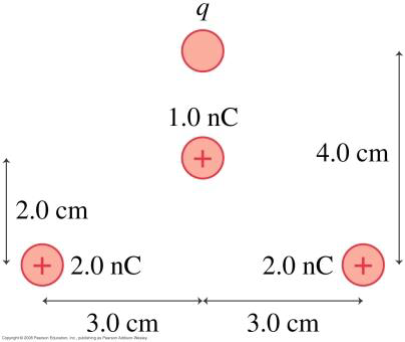
Step 1: Analyze the Forces
First, let's identify all the forces acting on our "test charge," the
- Force from the bottom-left
charge ( ). - Force from the bottom-right
charge ( ). - Force from the unknown top charge (
).
The principle of superposition states that the total force Fnet is the vector sum of these individual forces:
Since force is a vector, we must ensure both the horizontal (
Step 2: Exploit Symmetry (The x-components)
This problem has a wonderful built-in symmetry.
- The two bottom charges (
and ) are identical ( ). - They are at equal distances from
. - Since like charges repel,
pushes up and to the right. - Symmetrically,
pushes up and to the left.
Think of it like two people of equal strength pushing a bowling ball from opposite, angled directions. Their sideways pushes cancel each other out, and the ball only feels a net push forward.
Because the horizontal pushes are equal and opposite, their
The top charge
Step 3: Balance the Vertical Forces (The y-components)
Now we just need to solve ΣFy=0.
This means the total upward force must equal the total downward force.
- Upward Force: Both
and are repelling , so they both create an upward ( ) force. The total upward force is . - Downward Force: For the net force to be zero, the force from
( ) must be purely downward (in the direction) to counteract the upward push.
For
Step 4: The Calculation 🧮
Our goal is to set the magnitude of the upward force equal to the magnitude of the downward force:
Let's find these magnitudes.
-
Find the Downward Force (
): - This one is easier. The distance between
and is . - Using Coulomb's Law (F=kr2∣qaqb∣):
- This one is easier. The distance between
-
Find the Upward Force (
): - This is
. Since the setup is symmetric, , so we can just find one and double it: . - First, find the distance r1 from q1 to qc using the Pythagorean theorem:
- This is
- The magnitude of the total force F1 (the diagonal one) is:
- We only want the y-component, F1,y. We can use similar triangles. The ratio of the y-component of the force to the total force is the same as the ratio of the vertical distance to the total distance.
- So,
- Now let's find the total upward force Fup=2⋅F1,y:
- Set the Forces Equal and Solve:
Let's simplify this. The
Let
(This comes from 2⋅(kr12q1qc)⋅(r1yc)=krq2∣q∣qc)
Now, let's solve for ∣q∣:
Let's plug in the values (we can use cm here, as the units will cancel out, but it's safer to use meters):
-
-
-
-
Rounding to two significant figures (like the given data), we get
Conclusion
From our calculation, the magnitude of the charge is 0.68 nC.
From our analysis in Step 3, we know the charge must be negative to create the necessary downward attractive force to balance the upward repulsive forces.
Therefore:
q=−0.68 nC
Question n3
A charged cork ball of mass
the ball is in equilibrium at an angle
Find
(a) the charge
(b) the tension
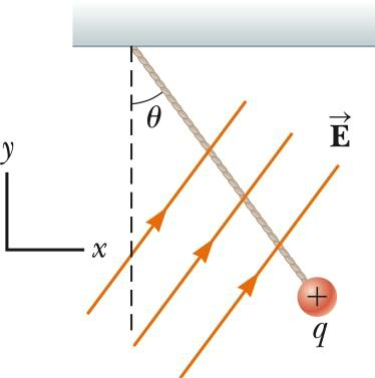
This is a fantastic problem that combines Newton's Laws with electrostatics. The key here is that the ball is in equilibrium, which simply means it's hanging motionless. Because it's not accelerating, we know from Newton's First Law that all the forces acting on it must cancel out perfectly.
Here are the solutions, followed by the step-by-step breakdown of how we get them:
(a) The charge on the ball is q=1.09×10⁻⁸ C (or 10.9 nC).
(b) The tension in the string is T=5.44×10⁻³ N.
Step 1: The Free-Body Diagram
First, let's identify all the forces acting on the cork ball. This is the most important step!
- Gravity (
): This force pulls the ball straight down. Its magnitude is . - Tension (
): The string pulls the ball up and to the left, along the string at an angle from the vertical. - Electric Force (
): The electric field exerts a force . Since the field has components "up" (y) and "right" (x), this force pulls the ball up and to the right.
Step 2: The Equilibrium Equations
For the ball to be in equilibrium, the net force in both the horizontal (x) and vertical (y) directions must be zero.
Let's break our three forces into their
- Gravity:
(pointing down)
- Tension: (The angle
is with the vertical -axis) (pointing left) (pointing up)
- Electric Force: (
)
Now, we build our two "sum of forces" equations:
: :
Step 3: The Calculation (Solving for
We have two equations and two unknowns (
(a) Finding the charge
Let's solve for
From Equation 1:
Now, substitute this T into Equation 2:
Factor out q:
(Remember that cos(θ)/sin(θ)=1/tan(θ))
Now, solve for q:
Let's plug in the numbers:
q≈1.09×10⁻⁸ C
(b) Finding the tension
Now that we have q, we can use our simple expression for T from Equation 1:
T≈5.44×10⁻³ N
Question 4
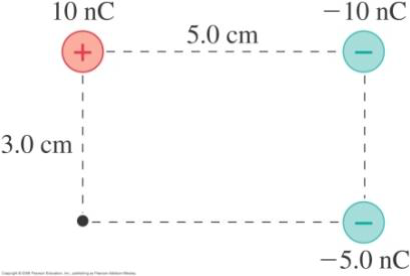
Refer to the diagram on the right for a system of three charges fixed at three corners of a rectangle.
What are the strength and direction of the electric field at the position indicated by the dot (in the fourth corner) in the diagram? Give your answer in vector form.
Are there any neutral points for this layout of charges? If yes, where are they located?
(a) Electric Field at the Dot
The net electric field
(top-left) (top-right) (bottom-right)
The final answer, in vector form, is:
Enet=(4.07×10⁴i−8.64×10⁴j) N/C
Here is the step-by-step calculation to get that answer.
Step 1: Set up the coordinate system
Let's place the origin
- The dot (Point
) is at: is at: is at: is at:
We'll use Coulomb's constant,
Step 2: Calculate the E-field vector from each charge
Recall that the electric field from a positive charge points away from it, and the field from a negative charge points toward it.
- Field from
( ): is a positive charge directly above the dot. - The field
must point away from , so it points straight down (in the direction). - Distance
. - Magnitude
.
- Field from
( ): is a negative charge directly to the right of the dot. - The field
must point toward , so it points straight right (in the direction). - Distance
. - Magnitude
.
- Field from
( ): is a negative charge at the far diagonal corner. - The field
must point toward (up and to the right). - Distance
is found using Pythagoras: . So, . - Magnitude
. - Now we need its
and components. We find the angle from the -axis: . .
Step 3: Sum the vectors
Now we just add the components together.
-component: -component:
Rounding to three significant figures, our final vector is:
This means the field has a total strength of
(b) Neutral Points
A neutral point is any location where the net electric field is exactly zero (
Yes, there is a neutral point, but it is not in a simple location.
-
Why not inside? Let's test any point inside the rectangle.
(positive) will create a field pointing down and to the right. (negative) will create a field pointing up and to the right. (negative) will create a field pointing down and to the right. - Notice that all three charges create a field component that points to the right (a positive
-component). Since they all add, the -component of the field can never be zero inside the rectangle. Therefore, no neutral point can exist inside the rectangle.
-
So, where is it?
The net charge of this system is qnet=(+10)+(−10)+(−5)=−5 nC.
- Very close to the
charge, the field is strong and points outward, away from that charge. - Very far away from the whole system, the field acts like that of a single
point charge, meaning the field lines point inward, toward the system.
Since the field points "out" in one region and "in" in another, there must be a point somewhere (in this case, to the left of the rectangle) where the field lines reverse and the electric field is exactly zero. Finding its precise location would require solving a very complex system of equations, but we can say for sure that one does exist.
- Very close to the