Q2
A motorcycle is traveling at a speed of 72
The Problem: Stopping Distance
We have a motorcycle moving at a certain speed and then decelerating to a stop. We want to find the minimum distance it covers during this braking process. This is what we call the stopping distance.
1. Identify What We Know (Given Information)
- Initial Speed (
): The speed of the motorcycle before it applies the brakes. - Final Speed (
): The speed of the motorcycle after it comes to a stop. (It stops!)
- Deceleration (
): The rate at which the motorcycle's speed decreases. . Since it's deceleration (slowing down), we'll treat this as a negative acceleration in our equations: . (The acceleration vector points opposite to the velocity vector).
2. Identify What We Want to Find
- Stopping Distance (
): The minimum distance required for the motorcycle to stop.
3. Crucial First Step: Unit Conversion!
Physics problems always require consistent units. Notice our speed is in kilometers per hour (km/h) but our acceleration is in meters per second squared (m/s²). We must convert the initial speed to meters per second (m/s).
Here's how we do it:
- 1 km = 1000 m
- 1 hour = 3600 s
Now all our units are consistent (meters and seconds)!
4. Choose the Right Kinematic Equation
We're looking for distance (
The best kinematic equation for this scenario is:
This equation directly relates initial velocity, final velocity, acceleration, and displacement (
5. Plug in the Values and Solve!
Now, let's substitute our known values into the equation:
Now, we need to isolate
Add
Divide both sides by
6. The Answer and What It Means
The minimum safe distance required for the motorcycle to stop is 50 meters.
Why "minimum safe distance"? This calculation assumes ideal braking conditions – the brakes are applied instantly, the deceleration is constant, and there are no external factors like reaction time or varying road conditions. In reality, a driver's reaction time and less-than-perfect braking can significantly increase the actual stopping distance.
Q3
"Two cars start from the same point. Car A accelerates from 0 m/s to 100 m/s over 20 seconds, while Car B travels at a constant speed of 60 m/s. Let's evaluate the following statements:
- The displacement of Car A from 0 to 20 seconds is 1000 meters.
- At t = 12 seconds, Car A and Car B are at the same point.
- The average speed of Car A from 0 to 20 seconds is less than the average speed of Car B over the same time interval.
- If the car movement continues until t = 25 seconds, Car A will overtake Car B.
Excellent analysis work, class! This problem tests our ability to apply kinematics uniformly and carefully consider the details of motion for each object. Let's break down each statement.
First, let's establish the equations of motion for both cars. Both cars start from the same point, so we can set their initial position
Car A Analysis:
- Initial velocity
- Final velocity (at
) - Time interval
Since Car A accelerates uniformly, we can find its acceleration:
Now we can write the kinematic equations for Car A for
- Velocity:
- Position:
Car B Analysis:
- Constant speed
The kinematic equation for Car B:
- Position:
Now, let's evaluate each statement:
Statement 1: The displacement of Car A from 0 to 20 seconds is 1000 meters.
We can use Car A's position equation at
Alternatively, using the average velocity for constant acceleration:
Conclusion for Statement 1: TRUE.
Statement 2: At t = 12 seconds, Car A and Car B are at the same point.
Let's find the position of each car at
- Position of Car A at
:
- Position of Car B at
:
Since
Conclusion for Statement 2: FALSE.
Statement 3: The average speed of Car A from 0 to 20 seconds is less than the average speed of Car B over the same time interval.
- Average speed of Car A (0 to 20 s):
For constant acceleration, average speed is.
(Or total distance / total time:). - Average speed of Car B (0 to 20 s):
Since Car B travels at a constant speed, its average speed is simply.
Comparing the average speeds:
Conclusion for Statement 3: TRUE.
Statement 4: If the car movement continues until t = 25 seconds, Car A will overtake Car B.
This statement requires careful interpretation. "Car A accelerates from 0 m/s to 100 m/s over 20 seconds" describes the motion during the first 20 seconds. It typically implies that after 20 seconds, unless stated otherwise, Car A would maintain the velocity it achieved at the end of that acceleration period.
So, let's establish Car A's motion for
- At
: and . - For
, Car A travels at a constant velocity of .
The position of Car A foris:
Now, let's find the positions at
- Position of Car A at
:
- Position of Car B at
:
At
(Note: If we had assumed Car A's acceleration of
Conclusion for Statement 4: FALSE.
Final Summary:
- Statement 1: TRUE
- Statement 2: FALSE
- Statement 3: TRUE
- Statement 4: FALSE
Qso
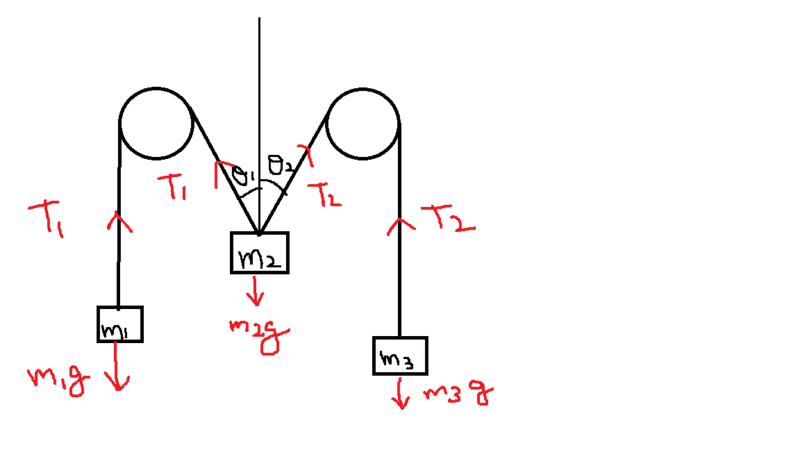
Determine the masses m₁ and m₃ in the three-mass, two-pulley system shown, given that θ₁ = 30°, θ₂ = 60°, and m₂ = 0.5M.
Given Information:
- Angle
- Angle
- Mass
(where 'm' is some reference mass) - The system is in equilibrium.
Step 1 & 2: Free-Body Diagrams and Forces
Let's look at each mass individually. Remember, for ideal pulleys and ropes, the tension in a continuous rope section is constant.
- For mass
: - Downward force: Gravity,
- Upward force: Tension,
- Since the rope connecting
to goes over a pulley, the tension in that part of the rope is also .
- Downward force: Gravity,
- For mass
: - Downward force: Gravity,
- Upward force: Tension,
- Similarly, the tension in the rope connecting
to is .
- Downward force: Gravity,
- For mass
: - Downward force: Gravity,
- Upward-left force: Tension,
, acting at an angle from the vertical. - Upward-right force: Tension,
, acting at an angle from the vertical.
- Downward force: Gravity,
Step 3: Apply Newton's First Law (
Since the system is in equilibrium, the net force on each mass is zero.
A. For mass
The forces are only in the vertical direction.
B. For mass
The forces are only in the vertical direction.
C. For mass
This is where we need to resolve forces into their components. Let's use a standard Cartesian coordinate system, with positive x to the right and positive y upwards.
-
Vertical (y) components:
- The vertical component of
is (upwards). - The vertical component of
is (upwards). - The gravitational force
is downwards.
So,
(Equation 3) - The vertical component of
-
Horizontal (x) components:
- The horizontal component of
is (to the left, so negative). - The horizontal component of
is (to the right, so positive).
So,
(Equation 4) - The horizontal component of
Step 4: Solve the System of Equations
Now we have a set of equations and known values. Let's substitute and simplify.
Substitute Equation 1 (
We can cancel 'g' from both sides:
Plug in the given angles:
Multiply both sides by 2:
Now, substitute Equation 1 and Equation 2 into Equation 3:
Again, cancel 'g' from all terms:
Plug in the given angles and
Multiply both sides by 2:
Now we have a system of two equations with two unknowns (
Substitute Equation 5 into Equation 6:
Now that we have
Final Answer:
Therefore, the masses are: