Structured Questions
Question 1
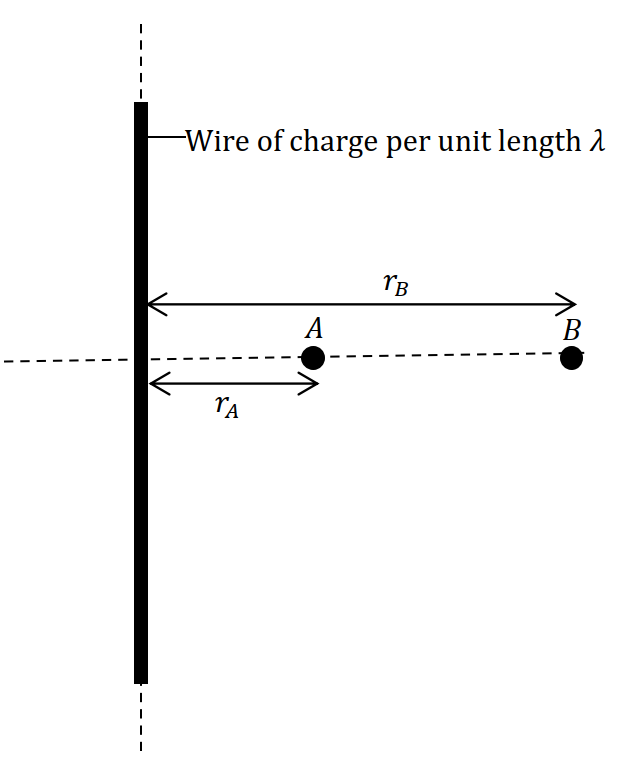
Electric charge is distributed uniformly along an infinitely long thin wire. The charge per unit length is
a. Using Gauss’s Law, determine the expression of the electric field
b. In the figure, it is given that the charge per unit length is
i. Determine the initial acceleration (in m/s
ii. Given that the electrical potential difference between points A and B is given by
determine the speed (in m/s) of the object when it reaches point B where
Solution
Part a. Electric Field using Gauss's Law
The goal here is to find the electric field
1. Identify the Symmetry and Choose a Gaussian Surface
Since the wire is infinitely long and has a uniform linear charge density
- Be radially outward (if
is positive) or radially inward (if is negative) from the wire. It cannot have a component parallel to the wire due to the wire's infinite length (symmetry). - Have the same magnitude at all points equidistant from the wire.
The ideal Gaussian surface that exploits this symmetry is a coaxial cylinder of radius
2. Apply Gauss's Law
Gauss's Law states that the total electric flux (
where
3. Calculate the Electric Flux (
The cylindrical Gaussian surface has three parts: two flat circular ends and the curved side.
- Ends: The electric field
is perpendicular to the ends' area vectors . Thus, , and the flux through the ends is zero. - Curved Side: On the curved side,
is perpendicular to the surface (radial) and has constant magnitude at a fixed radius . The area vector is also perpendicular to the surface (radial). Thus, and are parallel, so .
The total flux is:
The integral
4. Calculate the Enclosed Charge (
The charge enclosed within the Gaussian cylinder of length
5. Solve for the Electric Field (
Substitute
The length
The expression for the electric field
Part b. Dynamics and Energy
Now we'll use this result, along with the given values, to analyze the motion of a charged object.
Given values:
- Linear charge density,
- Object mass,
- Object charge,
- Permittivity of free space,
i. Initial Acceleration at Point A
To find the acceleration, we first need to find the electric force on the object using Newton's Second Law (
1. Calculate the Electric Field at
Using the result from part a with
We can use the constant
2. Calculate the Electric Force at
The force
3. Calculate the Initial Acceleration (
Using Newton's Second Law,
The initial acceleration of the object is
ii. Speed at Point B
To find the speed at point B, where
1. Relate Work, Potential Difference, and Kinetic Energy
The work done by the electric field as the charge moves from A to B (
The potential difference
By the Work-Energy Theorem, this work must equal the change in kinetic energy:
Since the object starts at rest at A, the initial kinetic energy
Therefore:
2. Substitute the Expression for
We are given:
Substitute this into the energy equation:
3. Calculate
First, let's calculate the numerical value for
- Ratio:
(or V/m)
4. Solve for
Rearrange the energy equation to solve for
Substitute the values:
The speed of the object when it reaches point B is approximately
Question 2
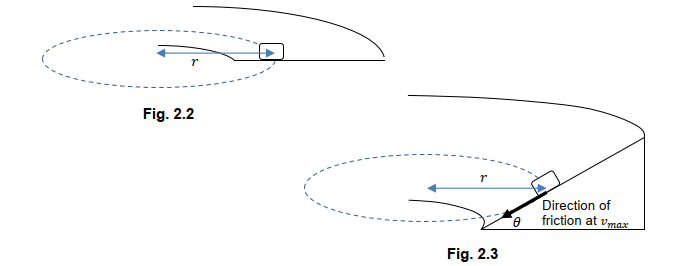
Cycling events in 2020 Tokyo Olympics featured five disciplines – BMX Freestyle, BMX Racing, Road, Mountain and Track Cycling. Track cycling takes place in a velodrome where the sides are banked. This allows track cyclists to reach maximum speeds that are far greater than the average speed when cycling on a flat road. Fig. 2.2 and 2.3 shows an object rounding a curve on a flat surface and on a banked surface in a velodrome respectively. The radius of the path that the object makes,
a. Referring to Fig 2.2, determine the maximum speed (in m/s) at which the object can safely travel around the flat curve without skidding.
b. At maximum speed
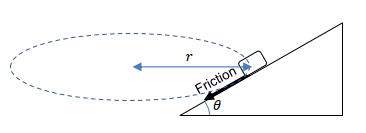
i. In addition to the frictional force identified for you, sketch labelled arrows to show the other two other forces acting on the object.
ii. Apply Newton’s second law on the object in the vertical and horizontal directions.
Vertical:
Horizontal:
iii. Using your answers in ii or otherwise, show that the maximum speed of the object
iv. If the stadium is built with angle
Solutions
Part a. Flat Curve (Fig. 2.2)
For an object to safely travel around a flat, horizontal curve without skidding, the force that provides the necessary centripetal acceleration (
-
Vertical Analysis (Forces Perpendicular to Motion):
On a flat road, the forces in the vertical direction (perpendicular to the surface) are the normal force (
) and the gravitational force ( ). Since there is no vertical acceleration, they must balance:
- Horizontal Analysis (Forces Providing Centripetal Force):
The maximum static friction provides the required centripetal force ():
- Solve for
:
Substitute
The mass (
- Calculation:
Using the given values:
The maximum speed the object can safely travel around the flat curve is
Part b. Banked Curve with Friction (Fig. 2.3)
i. Sketch of Forces
At the maximum speed
- Gravitational Force (
): Acting straight downward. - Normal Force (
): Acting perpendicular to the banked surface (up and away from the bank).
ii. Application of Newton’s Second Law
We will set up a coordinate system where the horizontal direction is towards the center of the circle (radial direction) and the vertical direction is straight up.
1. Resolve Forces into Components
The angle of the bank is
- Normal Force (
): - Horizontal component:
(towards the center) - Vertical component:
(upward)
- Horizontal component:
- Friction Force (
): Since friction is parallel to the bank and down the bank: - Horizontal component:
(towards the center) - Vertical component:
(downward)
- Horizontal component:
- Gravitational Force (
): - Horizontal component:
- Vertical component:
(downward)
- Horizontal component:
2. Vertical Equilibrium (
The object does not accelerate vertically.
At maximum speed
This matches the given vertical equation result.
3. Horizontal Motion (
The net horizontal force provides the centripetal force
Again, using
This matches the given horizontal equation result.
iii. Derivation of
We have two independent expressions for the Normal Force
- Cancel mass (
):
- Solve for
:
- Take the square root:
The derivation is complete and matches the required expression. This equation clearly shows that banking the curve (
iv. Maximum Speed Calculation
We use the derived formula with the given values:
First, calculate the trigonometric values:
Numerator:
Denominator:
Calculate
The maximum speed of the cyclist on the banked track is
Question 3
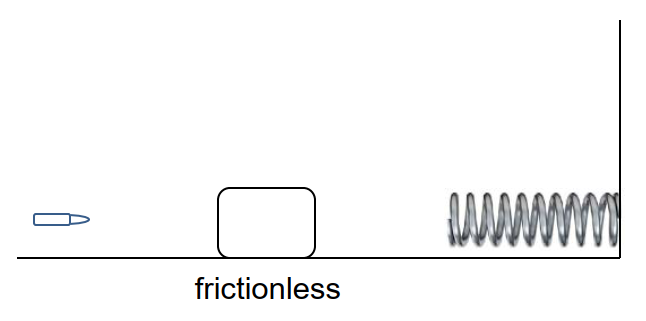
In the following cases, the mass of the bullet
i. In terms of
ii. If the spring constant of the spring is
iii. In reality, the surface has friction. If all the given values remain the same, how will the actual speed of the bullet be as compared to the value of
A. Larger
B. The same
C. Smaller
Solutions
Here are the given values:
- Mass of bullet,
- Mass of block,
- Initial speed of bullet,
(to be found) - Common final speed after collision,
- Maximum compression of spring,
- Spring constant,
- Surface is frictionless for parts (i) and (ii).
i. Expression for Common Speed
The collision between the bullet and the block is a perfect inelastic collision because the two objects stick together and move with a common final velocity
Initial Momentum (
Since the block is initially at rest,
Final Momentum (
After the collision, the bullet and block move together with speed
Conservation of Momentum (
Solving for the common speed
Substituting the numerical masses:
The expression for the common speed
ii. Determine the Speed of the Bullet
After the collision, the combined mass
Initial Energy (before spring compression):
The energy is purely kinetic energy of the combined mass:
Final Energy (at maximum compression
At maximum compression, the mass is momentarily at rest, so
Conservation of Energy (
Step 1: Solve for the common speed
Substituting the numerical values:
Step 2: Use the result from (i) to find
From part (i):
The initial speed of the bullet
iii. Effect of Friction
In this hypothetical scenario, the surface has friction, but all other values (
The total mechanical energy loss due to friction is equal to the work done by friction,
Energy Conservation with Friction:
Since
Because
This means the actual common speed
Since
If
The correct choice is A. Larger.