Physics 2024
Q2
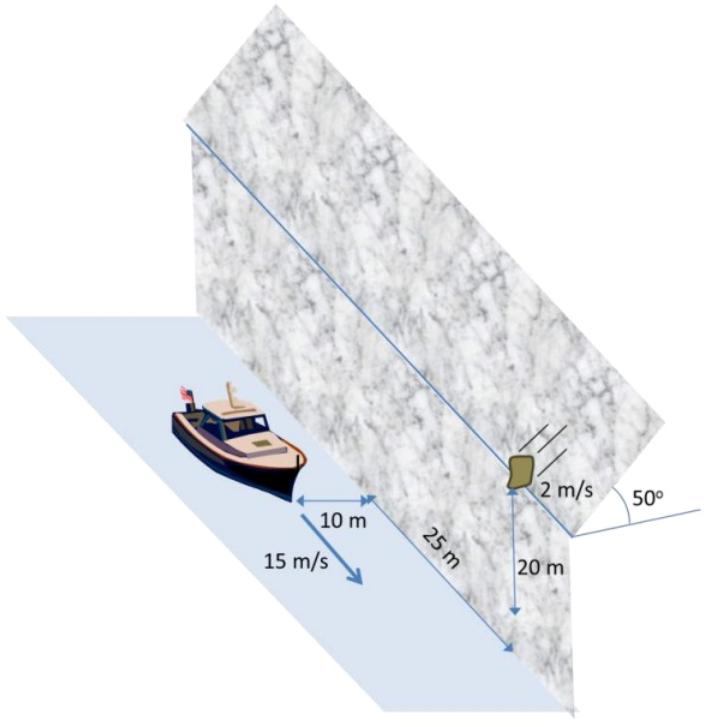
As shown in the figure, a
a) We denote the time for the rock to reach the same level as the front tip of the boat as
b) After the rock slides off at
a. Increasing to more than
b. Stay constant at
c. Reducing to less than
ANSWER
Good evening! Welcome to our virtual physics session. That's an excellent problem you've brought in—it combines constant velocity motion with projectile motion, which is a classic scenario. Let's break it down together, step-by-step, to make sure every part is clear.
Part a) Will the rock hit the boat?
To solve this, we need to answer a fundamental question: Are the rock and the boat in the same place at the same time? This means we need to analyze two things:
- Timing: Does the rock reach the water level during the time interval that the boat is passing underneath?
- Position: If the timing is right, does the rock land within the boat's width?
Let's start by calculating the times you mentioned,
Step 1: Calculate the time for the rock to fall (
The rock's fall is a projectile motion problem. The most effective way to handle these is to separate the motion into horizontal (x) and vertical (y) components.
Let's define our coordinate system:
- The origin (0, 0) is at the water level directly below where the rock starts to fall.
- The positive y-direction is upwards.
- The positive x-direction is away from the cliff.
The rock starts at an initial height
The initial velocity is
The negative sign is crucial because it's directed downwards.
Now, we can use the kinematic equation for vertical motion:
Plugging in our values:
Rearranging this gives us a quadratic equation:
We can solve for
So, the rock takes approximately
Step 2: Calculate the time for the boat to reach the impact zone (
The boat moves at a constant speed, so this calculation is more straightforward.
- Distance for the front tip of the boat to travel,
. - Speed of the boat,
.
The time it takes for the front of the boat to arrive at the point directly below the rock is:
So, the front tip of the boat reaches the "danger zone" at
Step 3: Compare times and check the boat's position
The rock hits the water at
But is the rest of the boat clear? Let's find out where the back of the boat is when the rock lands. The boat is
The time window during which the boat is passing under the rock's fall path is from when the front tip arrives (
Time for the rear to pass = Time for front to pass + Time to travel boat's length
So, some part of the boat is in the danger zone between
The rock lands at
Step 4: Check the rock's horizontal landing position
Does the rock actually land on the boat's deck? Let's calculate how far the rock travels horizontally away from the cliff.
The initial horizontal velocity is:
Ignoring air resistance, there's no horizontal acceleration. The horizontal distance (
The rock lands
Now, where is the boat?
- The center of the boat is
from the cliff. - The boat is
wide. - This means the boat occupies the space from
to away from the cliff.
The rock lands at
Conclusion for Part (a)
No, the rock will not hit the boat.
Explanation: While our time calculation shows that the boat is indeed passing under the drop point when the rock reaches the water level (the rock lands at
Part b) The angle of the rock's velocity
This is an excellent conceptual question about the nature of projectile motion. Let's analyze the velocity components.
- Horizontal Velocity (
): Since we ignore air resistance, there are no horizontal forces acting on the rock. According to Newton's first law, its horizontal velocity will remain constant throughout the fall. . - Vertical Velocity (
): The rock is constantly being accelerated downwards by gravity. This means its downward speed continuously increases. increases with time.
The angle of the velocity vector below the horizontal,
Since
If
Think of it this way: gravity is always pulling the rock more and more vertically. So, its path will become steeper and steeper. It starts at
Therefore, the correct answer is:
a. Increasing to more than
Q3
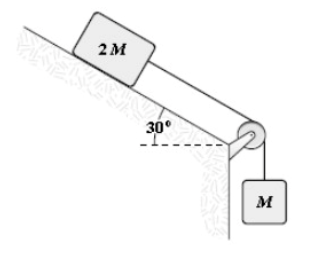
In the figure shown, two blocks are connected by a massless cable round a smooth pulley where friction is negligible. The block on the
- Determine the magnitude of the acceleration of the suspended block as it falls (before the block of mass
moving down the incline hits the pulley). - On the axes below, sketch to show how the distance of the suspended block (of mass
) from the pulley changes with time (before the block of mass moving down the incline hits the pulley). - Suggest one modification that can be made so that the magnitude of the acceleration (in part a) will be larger.
ANSWER
1) Choose sign convention.
Let
- for the block on the incline (
) take positive toward the pulley (so the accelerations are consistent: if goes down, the rope pulls toward the pulley). - for the hanging block (
) take positive downwards.
With this choice the two accelerations are the same scalar(opposite directions of their individual displacements).
Friction =
2) Draw free-body forces (along the directions we chose).
- On
(on the slope): tension acting up the slope, gravitational component acting down the slope, normal , kinetic friction acting opposite the motion (i.e. down the slope if tends to move up). - On
(hanging): gravity downward, tension upward.
3) Write Newton’s 2nd law for each mass (along the chosen axis).
Picture: the pulley sits at the lower end of the incline; moving toward the pulley means moving down the slope. Now the component
For
- Forces toward the pulley:
(tension) and . - Friction opposes motion, so if
moves toward the pulley friction acts away: .
Newton for
For
Add to eliminate
so
Now plug the numbers
Numerator
Divide by
So in this orientation the hanging block falls (positive
Great — we’ll continue case 2 (pulley at the lower end, so the block
Recap — acceleration
We derived
With
So the hanging block falls with constant acceleration
(b) Distance from the pulley vs time — equation and sketch
Let
With
Key kinematic facts to mark on the sketch:
- At
: and slope (instantaneous velocity) . - The graph is a parabola opening upward (concave up) — distance increases increasingly fast because the block is accelerating downward.
- Velocity vs time is linear:
(straight line through origin). - Acceleration vs time is constant:
(horizontal line).
If you want the time it takes to hit the pulley (i.e., to reduce the free length until the block
(Example: if
(c) One modification to make the magnitude of the acceleration larger
Suggestion: Increase the incline angle
Why: In the formula for this orientation,
increasing
for
Intuition: a steeper slope gives a larger component of
Other single changes that would also increase