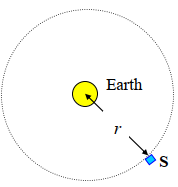
As shown in the figure, a satellite S of mass is orbiting Earth of mass in a circular path of radius . It is parked at a geostationary orbit, which means that it has the same period as Earth’s rotation (i.e. 24 h) and is able to maintain a constant position directly above a fixed point on Earth near the equator. The satellite has a mass of 700 kg. The mass of the Earth is kg.
a. Determine
i. the radius of this orbit, and
ii. the general formula for the total energy of a satellite in terms of its mass and orbital radius round Earth. You can include any other physical constants needed in your formula. Calculate the numerical value of the total energy for this satellite.
b. After a few years, the satellites may no longer function nor orbit correctly. One method of disposing dysfunctional geo-stationary satellites is to cause the satellite to be ‘de-orbited’ and made to crash into uninhabited parts of the Earth. Using this method, a satellite of mass 700 kg began to make its descent at 90 km above the Earth’s surface for 15 min just before impact. It stays at a constant speed all the way from initial descent to just before crashing. Assuming that all energy losses are converted only to heat, estimate the average rate of heat generated on the descent. (Hint: 90 km is considered to be close to Earth’s surface and the gravitational field strength can be treated as constant.)
c. Another method of disposing dysfunctional low flying satellite is by using the remaining fuel to propel them into a ‘graveyard orbit’—another orbit which is hundreds of kilometres from the geo-stationary orbit. In this method, the satellite is first given a velocity boost of about 11 m s in its original direction of motion and another boost later to keep the final orbit circular. Is the radius of this graveyard orbit larger or smaller compared to the original orbit? With reference to the total energy of the satellite, explain your answer.
Solutions
Part a: Geostationary Orbit Radius and Total Energy
For a satellite to maintain a stable circular orbit, the gravitational force exerted by the Earth must provide the necessary centripetal force required for circular motion.
i. Determining the Radius of the Orbit ()
We equate the gravitational force () to the centripetal force ():
Since the satellite is in a circular orbit, the centripetal acceleration () can be expressed in terms of its angular speed () or its orbital period (): . Since we are given the period , let's use the relationship .
Notice that the satellite's mass () cancels out—a great reminder that the orbital radius only depends on the mass of the central body () and the orbital period ().
Now, let's solve for the radius ():
Given Values:
Gravitational Constant,
Mass of Earth,
Period of orbit (Geostationary), . We must convert this to seconds: