Physics 2022 SQ
SQ-1
(a) Fill in the blank: Archimedes’ principle states that a body partially or fully immersed in a fluid experiences an upthrust equal to the ……….. of the fluid displaced by the object.
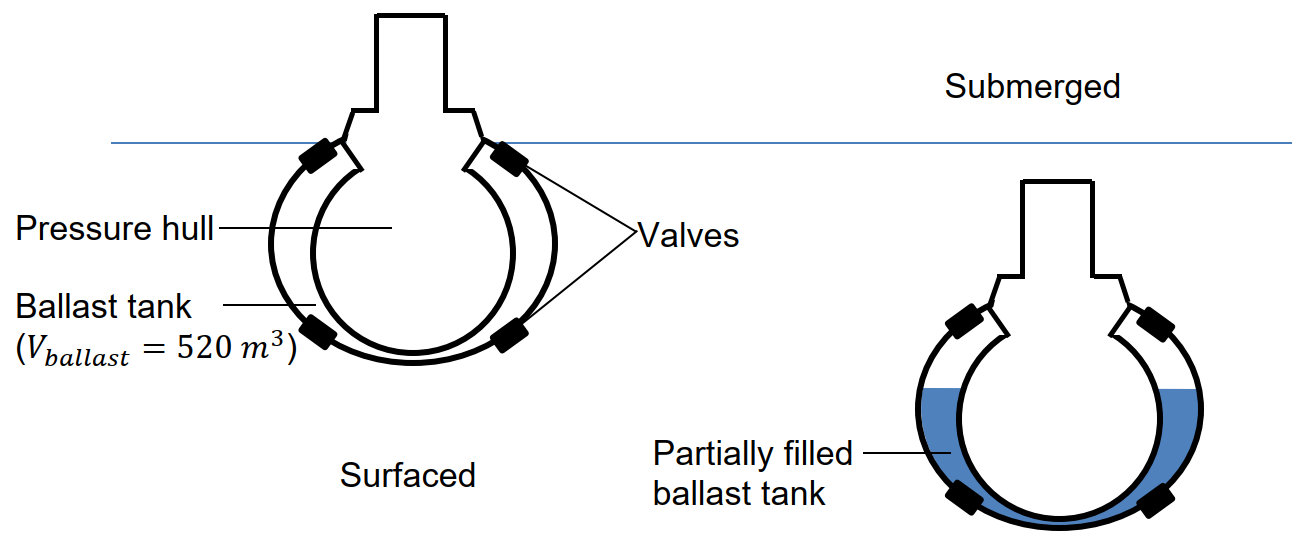
(b) A submarine vessel of mass
(i) Determine the volume
(ii) Determine the acceleration of the submarine when the ballast tanks are fully filled. You can neglect the effects of water resistance.
ANSWER
(a) Archimedes’ Principle
This first part is a fundamental concept. Let's get the definition just right.
Archimedes’ principle states that a body partially or fully immersed in a fluid experiences an upthrust equal to the weight of the fluid displaced by the object.
Think of it like this: when you get into a bathtub, the water level rises. The buoyant force (or upthrust) pushing you up is exactly equal to the weight of that extra volume of water you've pushed out of the way. It's the fluid fighting back to reclaim its space!
(b) The Submarine Problem
Now for the calculations. This is where we apply the principle. The key to solving this is to analyze the forces acting on the submarine in each situation. When the submarine is at rest (either surfaced or submerged), the forces are balanced. The upward buoyant force must exactly equal the downward force of its total weight.
Let's define our variables first:
= Mass of the submarine structure = Total volume of the submarine = Density of seawater = = acceleration due to gravity (we'll let this cancel out in most steps, but we'll need it for the final acceleration calculation) = Buoyant force (upthrust) = Total weight of the submarine (structure + water in tanks)
The two main forces are:
- Buoyant Force (upwards):
- Total Weight (downwards):
(i) Determine the volume
We have two scenarios given, which will give us two equations to solve for our two unknowns,
Scenario 1: Surfaced and at rest
The ballast tanks are empty, so the mass of water inside is zero (
Since it's at rest, the forces are balanced:
We can cancel
Let's call this Equation (1).
Scenario 2: Fully submerged and at rest
The submarine is completely underwater, so the submerged volume is its total volume,
The ballast tanks are filled with
The mass of this water is
The total mass is now
Again, it's at rest, so the forces are balanced:
Cancelling
Let's call this Equation (2).
Solving the Equations
Now we have a system of two equations. We can substitute Equation (1) into Equation (2).
Let's move the term with
Factor out
We can divide both sides by 1025, which simplifies things nicely:
So, the total volume of the submarine is approximately
Now we can find the mass
So, the mass of the submarine is approximately
(ii) Determine the acceleration of the submarine when the ballast tanks are fully filled.
This is a different situation! The forces are no longer balanced, which means there will be a net force, causing acceleration according to Newton's Second Law (
First, let's figure out the forces in this new scenario.
The ballast tanks are fully filled. The total volume of the tanks is given as
-
Total mass (
): This is the mass of the submarine structure ( ) plus the mass of the water in the full ballast tanks.
. . -
Total Weight (downwards,
):
. -
Buoyant Force (upwards,
): Since the submarine will be accelerating downwards, it is fully submerged. The buoyant force depends only on the total volume , which doesn't change.
.
Now, we find the net force (
Finally, we use Newton's Second Law,
Now we can solve for the acceleration,
The acceleration of the submarine is
SQ-3a
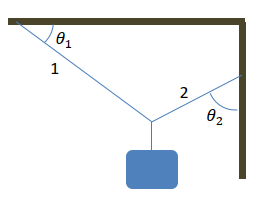
Two pieces of string labelled 1 and 2 are supporting a block of mass 4.0 𝑘𝑔. The angles are 𝜃_1 = 25° and 𝜃_2 = 40°. Calculate the tension 𝑇_1 and 𝑇_2 in the two strings 1 and 2 respectively.
ANSWER:
Step 1: Identify the Forces (Free-Body Diagram)
There are three forces pulling on this single point:
- Tension
: Pulling up and to the left along string 1. - Tension
: Pulling up and to the right along string 2. - Weight (W): The force of gravity pulling the block straight down. This is the tension in the vertical string.
The weight of the block is calculated using Newton's second law,
So, the downward pull is
Step 2: Set Up a Coordinate System and Resolve Forces
Because the forces
- For Tension
: The angle is given with respect to the horizontal ceiling. - Horizontal component (
): , pointing left (negative). - Vertical component (
): , pointing up (positive).
- Horizontal component (
- For Tension
: Be careful here! The angle is given with respect to the vertical wall. To use our standard sine and cosine functions relative to the horizontal axis, we need the angle with the horizontal. This angle is . - Horizontal component (
): , pointing right (positive). - Vertical component (
): , pointing up (positive).
- Horizontal component (
Step 3: Apply the Equilibrium Conditions
Since the block is in equilibrium, the net force in both the x and y directions must be zero.
Condition 1: Sum of horizontal forces is zero (
The rightward forces must balance the leftward forces.
Let's call this Equation (1).
Condition 2: Sum of vertical forces is zero (
The upward forces must balance the downward force (the weight of the block).
Let's call this Equation (2).
Step 4: Solve the System of Equations
Now we have two equations and two unknowns (
From Equation (1), let's express
Now, substitute this expression for
Let's factor out
Now, let's plug in the trigonometric values:
Finally, we can find
Conclusion
The tension in string 1 is
The tension in string 2 is
SQ-3b
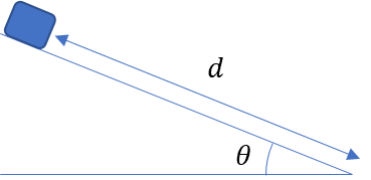
A block of mass 𝑚 slides from rest downwards along a rough slope of length 𝑑 long with kinetic coefficient of friction 𝜇𝑘 = 0.4. The angle of the slope is 𝜃.
(i) If 𝑚 = 1.2 kg, 𝑑 = 1.6 m and 𝜃 = 42∘, determine the magnitude of the velocity 𝑣 of the block at the bottom of the slope.
(ii) If 𝑚 = 1.2 kg, 𝑑 = 1.6 m and we require 𝑣 to be 4.0 m/s, determine 𝜃.
ANSWER:
The Big Idea: Work-Energy Theorem
The theorem states that the net work done on an object is equal to the change in its kinetic energy.
The "net work" is the sum of the work done by all forces acting on the block as it slides down the slope.
The forces doing work are:
- Gravity: It helps the block slide down.
- Friction: It opposes the block's motion.
Since the block starts from rest, its initial kinetic energy,
So our main equation is:
Let's break down the work terms. As the block slides a distance
- Work by gravity is
. (The component of gravity along the slope is ). - Work by friction is
. (It's negative because it opposes motion). The force of kinetic friction is . On a slope, the normal force balances the perpendicular component of gravity, so . This gives us .
Putting it all together, our master equation is:
Part (i): Find the velocity
Here, we are given:
Let's use our master equation. An interesting thing happens if we simplify it first by dividing everything by
Notice the mass
Now, we can solve for
Let's plug in the values (
So, the magnitude of the velocity at the bottom is approximately
Part (ii): Find the angle
Now the situation is reversed. We know the desired final velocity and need to find the angle of the slope that achieves it.
We are given:
Let's go back to our simplified work-energy equation:
Our goal is to solve for
Let's first isolate the part with the trig functions:
Now, let's calculate the value of the right-hand side:
So we need to solve the trigonometric equation:
This is a bit tricky to solve directly. A standard technique is to convert the left side into a single sine function of the form
Where
So the equation becomes:
Now we can take the inverse sine (arcsin):
Finally, solving for
So, the required angle is approximately