Physics 2022 SA
SA-1
The atmospheric pressure is 101325 N/m2. Convert the atmospheric pressure to the units pounds-per-square-inch (psi). You are given that 1 N = 0.2248 lb and 1 inch = 0.0254 metres.
ANSWERS:
Our goal is to convert a pressure given in Newtons per square meter (
We will do this in two parts: first, we'll figure out the conversion for the area (from square meters to square inches), and then we'll put it all together.
Step 1: Find the Area Conversion Factor
We are given the conversion for length:
To find the conversion for area, we simply need to square both sides of this equation:
This gives us a direct conversion factor between square inches and square meters.
Step 2: Set Up the Full Conversion
Now we can take our original value and multiply it by conversion factors. The key is to arrange the factors so that the old units cancel out, leaving us with the new units.
Our starting value is:
We want to convert Newtons (N) to pounds (lb) and square meters (
Let's use the factors you were given:
- Force:
- Area:
Now, let's combine them. We'll multiply our original value by the force conversion and the area conversion. Watch how the units cancel out:
Notice that the 'N' in the numerator of the first term cancels with the 'N' in the denominator of the second term. Likewise, the '
This leaves us with the units of
Step 3: Calculate the Final Value
Now we just need to multiply the numbers:
Rounding to a more standard number of significant figures, we get:
The atmospheric pressure is approximately 14.7 psi.
SA-2
For an object that travels at a fixed angular velocity in a circular path, the centripetal acceleration of the object is
A. in the same direction as the velocity of the object.
B. zero.
C. smaller in magnitude when the radius of the circle is smaller.
D. larger in magnitude when the radius of the circle is smaller.
E. in the opposite direction of the velocity of the object.
ANSWER
The key concept here is centripetal acceleration. An object moving in a circle is constantly changing its direction. Since velocity is a vector (with both magnitude and direction), a change in direction means a change in velocity. And a change in velocity, by definition, is acceleration.
The term "centripetal" means "center-seeking." This tells us that the acceleration vector for an object in uniform circular motion always points directly towards the center of the circle. This acceleration is what's responsible for pulling the object off its straight-line path and keeping it moving in a circle.
Now let's check the options:
- A. in the same direction as the velocity of the object. The velocity of the object is always tangent to the circle (pointing along the path). The centripetal acceleration points radially inward (towards the center). A tangent and a radius are always perpendicular to each other, so this is incorrect. ❌
- E. in the opposite direction of the velocity of the object. For the same reason as A, this is incorrect. The acceleration is perpendicular to the velocity, not parallel or anti-parallel. ❌
- B. zero. As we discussed, because the direction of the velocity is constantly changing, there must be an acceleration. So, this is incorrect. ❌
This leaves us with C and D, which are about the magnitude of the acceleration. To figure this out, we need the formula for centripetal acceleration (
(using linear speed, ) (using angular velocity, )
The question is very specific: it states the object travels at a fixed angular velocity (
Since
Let's re-examine options C and D:
- C. smaller in magnitude when the radius of the circle is smaller. According to our formula (
), if gets smaller (and stays the same), then will also get smaller. This statement is consistent with our analysis. ✔ - D. larger in magnitude when the radius of the circle is smaller. This contradicts our formula. This would be true if the linear speed (
) were held constant, because in the formula , acceleration is inversely proportional to radius. But the question specified constant angular velocity. ❌
The correct choice is indeed the one that matches the formula
The correct answer is C. smaller in magnitude when the radius of the circle is smaller.
SA-3
An air bubble of volume 0.050
The temperature at the bottom of the pond is 12°C and near the surface of the pond is 20°C. You can assume that the pressure near the surface of the pond is the same as the atmospheric pressure (1.013 × 10⁵ Pa). Density of water is 1000
ANSWER
- Identifying the Physics Principles
The key principle here is the Ideal Gas Law. Since the amount of air inside the bubble doesn't change as it rises, we can use a combined form of the gas law that relates the initial and final states of the bubble:
Where:
are the pressure, volume, and temperature of the bubble at the bottom of the lake. are the pressure, volume, and temperature of the bubble at the surface.
Our goal is to find
- Gathering Our Information (Knowns)
Let's list what we know for each state.
State 1: At the bottom of the lake
- Initial Volume (
): - Depth (
): - Initial Temperature (
):
State 2: At the surface of the lake
- Final Volume (
): This is what we need to find! - Final Temperature (
):
Constants and other given values:
- Atmospheric Pressure (
): - Density of water (
): - Acceleration due to gravity (
): Approximately
- Step-by-Step Calculation
Let's solve this one step at a time.
Step A: Convert Temperatures to Kelvin
The ideal gas law requires temperature to be in an absolute scale, which is Kelvin (K). The conversion is:
Step B: Calculate the Pressure at the Bottom (
The total pressure at the bottom of the lake is the sum of the atmospheric pressure pushing down on the surface and the pressure from the weight of the water above the bubble (hydrostatic pressure).
The formula for hydrostatic pressure is
or
Now, add the atmospheric pressure to get the total pressure at the bottom:
Step C: Determine the Pressure at the Surface (
The problem states that the pressure at the surface is the atmospheric pressure.
Step D: Solve for the Final Volume (
Now we have all the pieces to use our main equation. Let's start with:
We want to isolate
Now, let's plug in our values:
Let's calculate the ratios first:
- Pressure ratio:
- Temperature ratio:
Now multiply everything:
Conclusion
The volume of the air bubble when it arrives at the surface is approximately
Notice how much the bubble expanded! It's about three times its original size. This is mainly because the pressure exerted by the 20 meters of water was removed, allowing the gas to expand significantly. The small increase in temperature also contributed slightly to the expansion.
SA-4
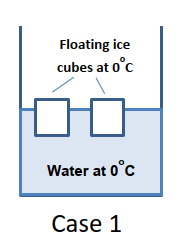
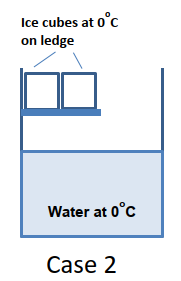
Determine what happens to water level when all the ice melts in each case. Density of ice at 0°C is 0.917
Please choose your answer:
In Case 1:
Water level:
(a) decrease (b) stays the same (c) increase
Case 2:
Water level:
(a) decrease (b) stays the same (c) increase
Hope that you will get some insights on melting ice and ocean level. The ice cubes on ledge is analogous to ice and snow on land. In fact, the main contributor to ocean level rise is the volume of the ocean is expanding as the water warms due to global warming.
ANSWER
This is a classic thought experiment in physics that beautifully illustrates the principles of buoyancy and density.
Let's tackle each case one by one.
Case 1: Floating Ice Cubes
This scenario is governed by Archimedes' Principle, which states that the buoyant force on a submerged object is equal to the weight of the fluid that the object displaces.
-
Why does ice float? Ice floats because it is less dense than liquid water.
while . -
How much water does it displace? For a floating object, the buoyant force must exactly balance its weight. This means:
- Weight of ice = Weight of displaced water
- Since weight is mass times gravity (
), this means the mass of the ice is exactly equal to the mass of the water it displaces.
-
What happens when it melts? When the ice melts, it turns into water. Due to the conservation of mass, the mass of this newly melted water is, of course, the same as the original mass of the ice.
-
Putting it all together:
- The ice cube displaces a mass of water equal to its own mass.
- When it melts, it becomes a mass of water equal to its own mass.
- Therefore, the melted water has a volume that is exactly equal to the volume of the water that the ice cube was displacing when it was floating.
The melted water perfectly fills the "hole" in the water that the submerged part of the ice cube was occupying.
Conclusion for Case 1: The water level (b) stays the same.
Case 2: Ice Cubes on a Ledge
This case is much more straightforward.
- Initial State: You have a container with a certain volume of water, which gives you an initial water level. The ice is completely separate from this water; it is not displacing any of it.
- What happens when it melts? The ice melts and turns into liquid water. This liquid water then drips down from the ledge and is added to the water already in the container.
- Putting it all together:
- You are adding a new volume of water to the container that wasn't there before.
- Adding more liquid to a container will naturally cause the level of the liquid to rise.
Think of it this way: the ice on the ledge is like pouring in water from a separate glass.
Conclusion for Case 2: The water level (c) increase.
Relationship with Sea-Level Rise
- Case 1 is analogous to floating sea ice, like the Arctic ice cap or icebergs. If all the floating ice in the world were to melt, it would not, by itself, cause a significant change in sea level.
- Case 2 is analogous to ice that is currently on land, such as the massive glaciers on Greenland and the ice sheets of Antarctica. When this land-based ice melts, the water flows into the oceans, adding new volume and causing sea levels to rise. This is a major concern related to climate change.
As the oceans warm, the water itself expands, and this effect is indeed one of the largest contributors to observed sea-level rise.
SA-5
You bought a cup of soft drink and you would like to chill it down without diluting
it too much. If the volume of the drink is 300
be about 21°C at thermal equilibrium, how many pieces of 2.0 g of ice at −5°C should you add in order to achieve that?
(You can assume that your drink has the same density as water, 1.0 g/cm³ and there is no heat exchanged with the surroundings. The specific heat capacity of ice is 2100 J/kg°C, latent heat of fusion of ice is 333 kJ/kg and the specific heat capacity of water is 4186 J/kg°C.)
ANSWER
The fundamental principle we'll use here is the conservation of energy. In an isolated system (as we've assumed), the total heat energy is constant. This means that the heat lost by the warm drink must be equal to the heat gained by the cold ice.
We can write this as an equation:
Let's figure out what's happening on each side of this equation.
- Heat Lost by the Soft Drink
The drink is only cooling down, without changing its state (it stays liquid). The heat it loses is called sensible heat, and we can calculate it using the formula:
Where:
is the mass is the specific heat capacity is the change in temperature
First, let's find the mass of the drink. We're given the volume and density.
- Mass = Density × Volume
- In standard SI units, this is
.
Now, let's calculate the heat lost. The drink cools from
So, the drink needs to lose
- Heat Gained by the Ice
The ice goes through a more complex process. It has to complete three steps to reach the final temperature of
-
Step 1: Heating the ice to its melting point. The ice warms from
to .
-
Step 2: Melting the ice. The ice at
turns into water at . This requires latent heat of fusion.
-
Step 3: Warming the melted water. The water that just melted (which is now at
) warms up to the final temperature of .
The total heat gained by the ice is the sum of these three parts:
- Solving for the Mass and Number of Ice Cubes
Now we can return to our main principle:
Let's solve for the total mass of ice,
Converting this back to grams:
The problem states that each ice cube has a mass of
- Number of cubes =
- Number of cubes =
pieces
Since you can't add
- If you add 7 cubes, you won't quite reach the target temperature of
(it will be slightly warmer). - If you add 8 cubes, the final temperature will be slightly colder than
.
Given the goal is to chill the drink, it's generally better to make it slightly colder. Therefore, you should add 8 pieces of ice.
SA-6
The position x of an object varies with time by
(i) Determine how the velocity of the object varies with time.
(ii) Determine the displacement of the object between the first and second time it is momentarily at rest.
ANSWER:
The relationship between position, velocity, and acceleration is all about derivatives. Velocity is the rate of change of position, so to get the velocity function, we take the first derivative of the position function with respect to time.
(i) How the velocity of the object varies with time
We are given the position function:
To find the velocity,
- Differentiate
: - Differentiate
: - Differentiate
: - Differentiate the constant
:
Combining these terms gives us the velocity function:
The velocity is in meters per second (m/s). This equation tells us the object's instantaneous velocity at any given time
(ii) Displacement between the first and second time it is momentarily at rest
This part has a few steps. Let's work through them logically.
Step 1: Find when the object is at rest.
"Momentarily at rest" means the object's instantaneous velocity is zero. So, we need to find the times (
This is a quadratic equation. We can solve for
This gives us two different times:
The first time,
The second time,
Step 2: Find the position at these two times.
Now we need to find where the object is at
Position at
Position at
To add these, let's find a common denominator (54) or use decimals for simplicity:
(Using fractions gives
Step 3: Calculate the displacement.
Displacement (
The displacement of the object between the first and second time it is momentarily at rest is approximately -1.59 m. The negative sign indicates that the object's final position during this interval is 1.59 m to the left (in the negative direction) of its starting position for the interval.
SA-7
In a relay race, runner A is carrying the baton and has a speed of 10.0 m/s. When runner A is 15.0 m behind runner B, runner B starts from rest and accelerates at
3.0 m/s2. How much time will runner A take to first catch up with runner B to pass the baton?
ANSWER:
- Establish a Coordinate System and Knowns
To make things simple, let's set the initial position of runner B as the origin,
Let's list what we know for each runner:
Runner A (Constant Velocity):
- Initial position,
- Velocity,
(This is constant)
Runner B (Constant Acceleration):
- Initial position,
- Initial velocity,
(Starts from rest) - Acceleration,
Our goal is to find the time,
- Write the Equations of Motion
Next, we'll write the general equation for the position of each runner as a function of time.
For Runner A, who has a constant velocity, the position is given by:
x_A(t) = -15.0 + 10.0t
x_B(t) = x_{B} + v_{B} t + \frac{1}{2} a_B t^2
x_B(t) = 0 + (0)t + \frac{1}{2} (3.0) t^2
x_B(t) = 1.5 t^2
x_A(t) = x_B(t)
-15.0 + 10.0t = 1.5t^2
1.5t^2 - 10.0t + 15.0 = 0
t = \frac{-(-10.0) \pm \sqrt{(-10.0)^2 - 4(1.5)(15.0)}}{2(1.5)}$$$$t = \frac{10.0 \pm \sqrt{100 - 90}}{3.0}$$$$
t = \frac{10.0 \pm \sqrt{10}}
t_1 = \frac{10.0 - \sqrt{10}}{3.0} \approx \frac{10.0 - 3.162}{3.0} \approx \frac{6.838}{3.0} \approx 2.28 , s
t_2 = \frac{10.0 + \sqrt{10}}{3.0} \approx \frac{10.0 + 3.162}{3.0} \approx \frac{13.162}{3.0} \approx 4.39 , s