Question 1
A satellite moves in a circular orbit at a constant speed around the Earth. Which of the following statements is true? (Select all that apply. Separate by “;” if more than 1 choice.)
A. No force acts on the satellite.
B. The satellite has an acceleration directed away from the Earth.
C. The satellite moves at constant speed and hence doesn't accelerate.
D. The satellite has an acceleration directed toward the Earth.
E. Work is done on the satellite by the gravitational force.
Answer: D
Analysis of Satellite Motion in a Circular Orbit
A satellite moving in a circular orbit at a constant speed around the Earth is a classic example of uniform circular motion. Let's analyze each statement based on the principles of physics.
A. No force acts on the satellite.
This is False.
- For the satellite to move in a curve (an orbit) rather than a straight line (as Newton's first law would dictate if no net force acted), there must be a net force.
- The force acting on the satellite is the gravitational force exerted by the Earth, which provides the necessary centripetal force to keep it in orbit.
B. The satellite has an acceleration directed away from the Earth.
This is False.
- The force (gravitational force) and the resulting acceleration are always directed in the same direction according to Newton's second law (
). - Since the gravitational force is always directed toward the center of the Earth, the acceleration must also be directed toward the center of the Earth. Acceleration directed away from the center would cause the satellite to move outward, away from the orbit.
C. The satellite moves at constant speed and hence doesn't accelerate.
This is False.
- While the speed (the magnitude of the velocity) is constant, the velocity (a vector quantity including both magnitude and direction) is continuously changing because the direction of motion is constantly changing.
- A change in velocity, whether in magnitude or direction, means there is an acceleration. This acceleration is the centripetal acceleration (
) and is what causes the direction of the velocity vector to change, keeping the satellite in its circle.
D. The satellite has an acceleration directed toward the Earth.
This is True.
- As established in B and C, for an object to move in a circle, it must have a centripetal acceleration (center-seeking acceleration).
- In this case, the center of the circle is the center of the Earth, and the centripetal acceleration is caused by the gravitational force. Therefore, the acceleration is directed toward the Earth.
E. Work is done on the satellite by the gravitational force.
This is False.
- Work (
) is defined as , where is the angle between the force vector ( ) and the displacement vector ( ). - In a circular orbit, the gravitational force (
) is directed radially inward (toward the center of the Earth). - The displacement (
) is always tangential to the circular path (in the direction of motion). - This means the force vector and the instantaneous displacement vector are always perpendicular (
). Since , the work done by the gravitational force is zero ( ). This is why the satellite's kinetic energy (and speed) remains constant.
Question 2
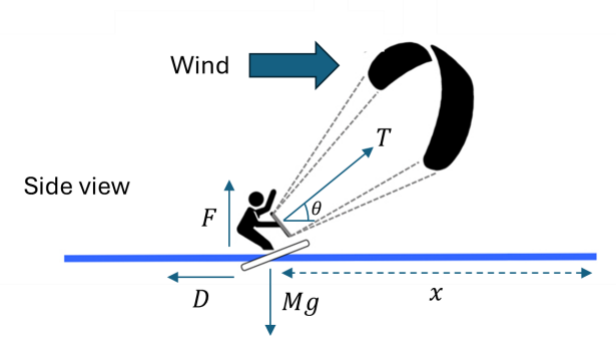
On 9 Aug 2024 during the Paris Olympics, Maximillian Maeder clinched the bronze medal for kitefoiling for Singapore. In a simplified analysis in the figure on the right, we model four forces acting on sportsman: a tension
Solutions
1. Identify the Forces and Components
We have four main forces acting on the sportsman and board:
- Tension (
) from the kite: at above the horizontal. - Drag force (
): horizontally opposite the direction of motion. - Upward force (
) from the foil: vertically upward. - Gravitational force (
) on the sportsman: , vertically downward.
Since the motion is purely horizontal for the distance
First, let's find the horizontal component of the tension force,
2. Calculate the Net Horizontal Force
The net force in the horizontal direction (
The net force acting on the sportsman in the direction of motion is approximately
3. Apply the Work-Energy Theorem
The Work-Energy Theorem states that the net work (
A. Calculate the Net Work Done (
Work is defined as Force multiplied by the distance moved in the direction of the force:
B. Relate Net Work to Change in Kinetic Energy (
The change in kinetic energy is the final kinetic energy (
Here,
4. Determine the Final Velocity (
Let's plug our values into the Work-Energy equation and solve for
Calculate the Initial Kinetic Energy (
Substitute
Isolate the final kinetic energy term:
Solve for
Solve for
The sportsman's velocity after he moves a horizontal distance of
Question 3
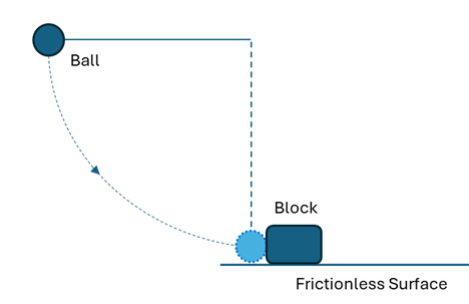
A 1.6-kg ball is attached to the end of a 0.40-m string to form a pendulum. This pendulum is released from rest with the string horizontal. At the lowest point of its swing, when it is moving horizontally, the ball collides with a 0.80-kg block initially at rest on a horizontal frictionless surface. The speed of the block just after the collision is 2.5 m/s. (Note that the collision is not elastic.)
a. Determine the tension (in N) in the string when the ball is at the lowest point just before hitting the block.
b. Determine the speed (in m/s) of the ball just after the collision.
Solutions
Here's the plan:
- Find the ball's speed just before the collision using the Conservation of Mechanical Energy for the pendulum swing.
- Determine the Tension at the lowest point using Newton's Second Law (specifically, for Circular Motion).
- Find the ball's speed just after the collision using the Conservation of Linear Momentum during the collision.
Let's start with part (a)!
a. Determine the tension in the string when the ball is at the lowest point just before hitting the block.
Step 1: Find the Speed of the Ball Just Before Collision (
We'll use the Conservation of Mechanical Energy as the ball swings down. Since the only forces doing work are gravity and the tension (which is always perpendicular to the displacement and thus does no work), mechanical energy is conserved. We'll set the lowest point as the reference for gravitational potential energy (
- Initial State (Top, Released from rest):
- Velocity:
- Height:
(where is the string length, )
- Velocity:
- Final State (Bottom, Just before collision):
- Velocity:
(what we want to find) - Height:
- Velocity:
The conservation of energy equation is:
Plugging in the known values (
Notice the mass of the ball (
Using the given values:
Step 2: Determine the Tension (
At the lowest point of the swing, the ball is moving in a circular path, so it has a centripetal acceleration (
The forces acting on the ball are:
- Tension (
), acting upward. - Gravity (
), acting downward.
The net force must equal
Solving for the Tension (
Plugging in the values:
The tension in the string just before hitting the block is 47.0 N (rounded to three significant figures).
b. Determine the speed of the ball just after the collision.
The collision between the ball and the block is a brief event where external forces (like gravity and the tension in the string) are negligible compared to the large internal contact forces. Therefore, we use the Conservation of Linear Momentum in the horizontal direction.
- System: Ball (
) and Block ( ). - Initial Momentum (Before collision):
- Final Momentum (After collision):
Known Values:
- Ball mass (
): - Block mass (
): - Ball speed before collision (
): (from part a) - Block speed before collision (
): (at rest) - Block speed after collision (
): - Ball speed after collision (
): Unknown
Apply Conservation of Momentum:
Plugging in
Now, solve for the ball's final speed (
The speed of the ball just after the collision is
Question 4
A wheel rotates about a fixed axis with an initial angular velocity of
Solving the Rotational Motion Problem
We are given the following information:
| Symbol | Quantity | Value |
|---|---|---|
| Initial angular velocity | ||
| Final angular velocity | ||
| Time interval | ||
| Angular displacement (what we need to find) |
We assume the angular acceleration (
Step 1: Choose the Correct Kinematic Equation
We need to find the angular displacement (
This equation is the rotational equivalent of finding the area under a velocity-time graph using the average velocity, which is valid only when acceleration is constant.
Step 2: Substitute the Values and Calculate
Now, we substitute the known values into the equation:
The units of seconds (
The wheel turns through
Question 5
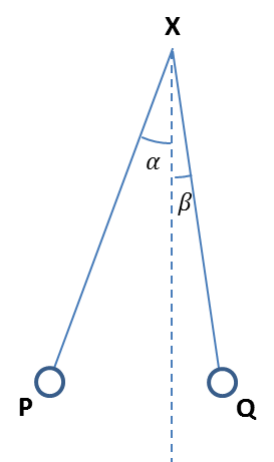
The diagram shows two small charged spheres P and Q of small mass which are hung by identical fine nylon threads from a fixed point X. It is found that, in equilibrium, the angle
A. The charge on P is numerically smaller than that on Q.
B. The charge on P is numerically greater than that on Q.
C. The mass of P is less than that of Q.
D. The mass of P is greater than that of Q.
E. The charges on P and Q are both positive.
Solutions
Analyzing the Forces on Each Sphere
Let's first establish the forces acting on each sphere, P and Q, when they are in static equilibrium:
- Gravitational Force (
): Directed vertically downward. ( ) - Tension Force (
): Directed along the nylon thread toward the fixed point X. - Electrostatic Force (
): Directed horizontally away from the other sphere (since they repel to achieve this configuration). This is the Coulomb force.
Since the system is in equilibrium, the net force on each sphere must be zero (
Free-Body Diagram and Equilibrium Equations
For any sphere (let's use a general angle
- Vertical Equilibrium: The vertical component of the tension must balance the weight.
- Horizontal Equilibrium: The horizontal component of the tension must balance the electrostatic force.
- Combining the Equations: Setting (Eq. 1) equal to (Eq. 2) gives:
Rearranging this to solve for the mass
Comparing Spheres P and Q
1. The Electrostatic Force (
The electrostatic force between P and Q is given by Coulomb's Law:
Crucially, by Newton's Third Law, the force P exerts on Q is equal in magnitude and opposite in direction to the force Q exerts on P.
Therefore, the magnitude of the electrostatic force is the same for both spheres,
2. Comparing the Masses (
We use the general result from (Eq. 3) and apply it to spheres P and Q:
| Sphere | Mass Equation | Given Condition |
|---|---|---|
| P | Angle is |
|
| Q | Angle is |
Since
We are given that
3. Analyzing the Cotangent Function
Recall the properties of the
- As the angle
increases (gets larger), decreases (gets smaller).
Since
4. Conclusion on Mass
Since
The mass of P is less than the mass of Q.
Final Check of Options
- A & B: Incorrect. The electrostatic forces must be equal in magnitude.
- C: Correct. We found
. - D: Incorrect.
- E: Incorrect. They must have charges of the same sign (both positive or both negative) for the repulsive force shown, but the exact sign isn't required to solve the problem (Coulomb's Law only uses the magnitude of the charges), and the statement "must be correct" is too strong, as they could both be negative.
The only statement that must be correct based on the angles being different is that the masses are different.
The correct statement is:
C. The mass of P is less than that of Q.
Question 6
The electric field just outside the surface of a hollow conducting sphere of radius
Solutions
What we're looking at here is a combination of two key principles: the properties of conductors in electrostatic equilibrium and Gauss's Law, specifically how it relates to superposition of electric fields.
Let's tackle this problem step-by-step.
Initial Electric Field (Before Charge
A crucial property of a hollow conducting sphere in electrostatic equilibrium is that any excess charge on the conductor resides entirely on its outer surface.
The electric field just outside the surface of a uniformly charged sphere is equivalent to the field of a point charge placed at its center, given by:
where:
is the initial electric field magnitude ( ). is Coulomb's constant ( ). is the total charge on the surface of the sphere. is the radius of the sphere ( ).
The field is directed outward, which means the initial charge on the surface,
New Electric Field (After Charge
When the unknown charge
- The charge
at the center creates its own electric field, . - By induction, the charge
will cause a redistribution of the surface charge on the conductor (the sphere).
However, a remarkable simplification comes from Gauss's Law and the principle of superposition. The total electric field just outside the sphere's surface,
Fortunately, for a point just outside the outer surface of the sphere, the total field,
We are given that the new field magnitude is
Finding the Charge
We can use the two electric field expressions to find
Step 1: Expressing the Charges in Terms of the Electric Field
From the initial state:
From the final state:
Step 2: Solving for
Now, we can substitute the expression for
Step 3: Plugging in the Values
Let's plug in the given values:
(We can keep it as until the end, or use the permittivity of free space if you prefer, but let's stick with for simplicity here).
The magnitude of the charge
Conclusion
The magnitude of the charge introduced at the center of the sphere is
The negative sign of
Question 7
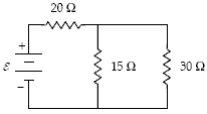
Determine the current in the 15-
Solutions
The core strategy here is to first simplify the entire circuit to find the total current supplied by the EMF (
Step 1: Simplify the Parallel Combination
The
The equivalent resistance (
To add the fractions, we find a common denominator (which is
Therefore, the equivalent resistance of the parallel section is:
Step 2: Determine the Total Equivalent Resistance
Now, the simplified parallel resistance (
Step 3: Calculate the Total Current (
The total current (
This total current (
Step 4: Calculate the Current in the
There are two primary ways to find the current
Method A: Using Voltage (The Fundamental Approach)
First, find the voltage across the parallel section (
The voltage drop across the
By Kirchhoff's Voltage Law, the sum of voltage drops must equal the EMF:
Now, use Ohm's Law specifically for the
Method B: Using the Current Divider Rule
The Current Divider Rule allows us to find the current
Wait! A simpler form for two resistors is actually better!
This form says the current splits inversely to the resistance; more current goes through the smaller resistance (
Final Answer
The current in the
Quick Check on Kirchhoff's Current Law:
The total current
The current in the
Check with Ohm's Law:
Question 8
Two parallel plates are separated by 0.5 mm. If the potential difference between them is 2.0 V, determine the magnitude of their surface charge densities.
Solutions
The problem requires us to find the surface charge density (
Step 1: Find the Magnitude of the Electric Field (
For a parallel plate capacitor (or two closely spaced parallel plates), the electric field (
We must first convert the separation distance (
Now, let's calculate the electric field magnitude:
Step 2: Relate the Electric Field to the Surface Charge Density (
For a parallel plate capacitor with a vacuum or air (which we assume here, as no dielectric is mentioned) between the plates, the electric field magnitude (
where
We can rearrange this equation to solve for the surface charge density (
Step 3: Calculate the Surface Charge Density (
Now, we substitute the electric field (
Rounding to two significant figures (based on the given values
The two plates will have surface charge densities of equal magnitude but opposite sign (one positive, one negative). Since the question asks for the magnitude of the surface charge densities, our final answer is:
Question 9
A 50-kg satellite circles the Earth in an orbit with a period of 120 min. Determine the minimum energy required to change the orbit to another circular orbit with a period of 180 min? (Earth: radius = 6400 km, Mass =
That is a fantastic problem in orbital mechanics! It requires us to combine Kepler's Third Law with the expression for the total mechanical energy of a satellite. The minimum energy required for the change is simply the difference between the total mechanical energy of the final orbit and the initial orbit.
Here is a step-by-step solution.
Given Data and Constants
| Variable | Symbol | Value |
|---|---|---|
| Satellite Mass | ||
| Earth's Mass | ||
| Earth's Radius | ||
| Gravitational Constant | ||
| Initial Period | ||
| Final Period |
Step 1: Relate Orbital Period (
For a circular orbit, Kepler's Third Law (modified for a satellite orbiting a central mass
We can rearrange this to solve for the orbital radius
Since the term
Calculate the constant
Calculate the Initial Radius (
Calculate the Final Radius (
Step 2: Calculate the Total Mechanical Energy in Orbit (
The total mechanical energy (
The energy required (
Calculate the common factor
Calculate the term
Step 3: Determine the Minimum Energy Required (
Finally, we calculate the required energy change:
The minimum energy required to change the orbit is