Physics 2023 - SA
SA-1
The “per square foot” price of a 5 bedroom flat is listed as
ANSWER
Step 1: Convert the Area to Square Feet
First, we need to convert the floor area from square meters (
To find the conversion factor for area, we need to square both sides of this equation:
Now, we can convert the total area of the flat:
Area in
Step 2: Calculate the Total Price
Now that we have the area in square feet, we can calculate the total price of the flat using the price per square foot:
Total Price = Area in
Total Price =
This gives us a final price of:
Total Price
So, the total price of the 5-bedroom flat is approximately $700,153.06.
SA-2
A boy got a balloon at the airport and brought it on an airplane. At the airport, the temperature was
ANSWER
The Governing Principle: The Combined Gas Law
This problem can be solved using the Combined Gas Law, which is a combination of Boyle's Law, Charles's Law, and Gay-Lussac's Law. It describes the relationship between the pressure, volume, and temperature of a fixed amount of gas. The law is expressed as:
Where:
are the initial pressure, volume, and temperature. are the final pressure, volume, and temperature.
Step 1: Convert Temperatures to the Absolute Scale (Kelvin)
A crucial step in any gas law problem is to convert all temperatures to an absolute scale. This is because the pressure and volume of a gas are directly proportional to its absolute temperature. The Kelvin scale is used for this, where
Let's convert the initial and final temperatures:
- Initial Temperature (
): - Final Temperature (
):
Step 2: Rearrange the Formula and Solve for the New Volume (
Our goal is to find the new volume,
Now, let's substitute the known values into this equation:
Calculating this gives us:
So, the new volume of the balloon at cruising altitude is approximately
SA-3
A car traveling along a straight road increases its speed from
ANSWER
- Identify the Knowns and Unknowns
First, let's list the information we are given in the problem:
- Initial speed (
): - Final speed (
): - Distance (
):
And what we need to find:
- Time elapsed (
): ?
- Select the Right Kinematic Equation
We have a set of equations for motion with constant acceleration. The key is to pick the one that lets us solve for our unknown (
One of the kinematic equations is:
This equation is perfect for our situation because it directly relates distance, initial speed, final speed, and time, without needing to know the acceleration first.
- Rearrange and Solve for Time (
)
Now, we need to rearrange the formula to solve for
- Substitute the Values and Calculate
Let's plug in the numbers from the problem:
So, the time that elapses while the car moves this distance is 6.0 seconds.
SA-4
Referring to the diagram, determine the magnitude of the resultant of these three forces.
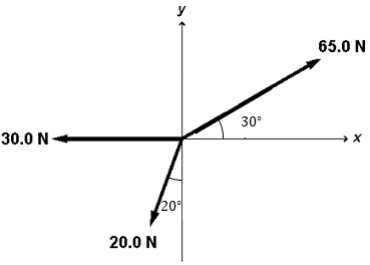
ANSWER
to find the resultant force, we need to sum up all the individual force vectors. The most straightforward way to do this is to break each force down into its horizontal (x) and vertical (y) components, sum those components, and then recombine them to find the final magnitude.
Let's go through it step-by-step.
Step 1: Resolve Each Force into its x and y Components
We'll analyze each of the three forces shown in the diagram.
Force 1: 30.0 N
This force points directly along the negative x-axis.
- x-component (
): -30.0 N - y-component (
): 0 N
Force 2: 65.0 N
This force is at an angle of 30° above the positive x-axis.
- x-component (
): - y-component (
):
Force 3: 20.0 N
This force is in the fourth quadrant, at an angle of 20° from the negative y-axis. We need to be careful here.
- The x-component is positive. Since the angle is given relative to the y-axis, we use sine:
- The y-component is negative. We use cosine for the y-component in this case:
Step 2: Sum the Components
Now, we add up all the x-components to get the resultant x-component (
-
Total x-component (
):
-
Total y-component (
):
Step 3: Calculate the Magnitude of the Resultant Force
We now have the two perpendicular components of our final resultant force (
Rounding to three significant figures (consistent with the given values), we get:
The magnitude of the resultant force is 35.9 N.
SA-5
Which of the following is / are not at constant acceleration? (Ignore air resistance and friction.)
A. The moment after a rock is thrown off the top of a building to just before it hits the ground.
B. An elevator moving from rest from the ground floor and stopping on the fifth floor.
C. Both A and B.
D. None of the above.
ANSWER
The correct answer is B. Here’s the detailed explanation for why:
A. The Rock Thrown Off a Building
- Analysis: The moment the rock leaves the hand, and ignoring air resistance, the only significant force acting on it is gravity. The force of gravity near the Earth's surface is constant, pulling the rock downwards.
- Conclusion: According to Newton's Second Law (
), a constant force results in a constant acceleration. In this case, the acceleration is the acceleration due to gravity, (approximately downwards). This value does not change throughout the rock's flight. Therefore, this is an example of constant acceleration.
B. The Elevator Moving and Stopping
- Analysis: Let's break down the elevator's journey.
- Starts from rest: The elevator's initial velocity is zero. To begin moving upwards, it must speed up. This change in velocity means it has an initial upward acceleration.
- Travels between floors: For a smooth ride, the elevator will likely travel at a constant velocity for some time. When the velocity is constant, the acceleration is zero.
- Stops: To stop on the fifth floor, the elevator must slow down. This change in velocity means it has a downward acceleration (deceleration) until its final velocity becomes zero.
- Conclusion: The elevator's acceleration changes throughout its trip (e.g., from positive to zero, then to negative). Since the acceleration is not the same at every moment, this is an example of non-constant acceleration.
Therefore, the elevator is the scenario that is not at constant acceleration.
SA-6
Your little sister wants you to give her a ride on her sled on snow. On level ground, if the same force
A. Pushing her from behind.
B. Pulling her from the front.
C. It is the same in both cases.
D. Not enough information.
E. It is impossible to move the sled this way.
ANSWER
The correct answer is B. Pulling her from the front.
Here’s the step-by-step reasoning behind it.
The Key Concept: Friction and the Normal Force
The amount of frictional force (
To make the frictional force smaller, we need to make the Normal Force smaller.
Analyzing the Two Methods
Let's look at the forces involved in each case. The sled has a weight (due to gravity) that always pushes straight down. The ground pushes straight up with the Normal Force.
A. Pushing the Sled
When you push your sister from behind, you naturally push at a slightly downward angle. This applied force (
- A horizontal component that pushes the sled forward.
- A vertical component that pushes the sled down into the snow.
This downward part of your push adds to the sled's weight, forcing the ground to push back up even harder. This increases the Normal Force.
Since the Normal Force is larger, the force of friction is also larger.
B. Pulling the Sled
When you pull the sled from the front, you typically use a rope, which means you pull at a slightly upward angle. This applied force (
- A horizontal component that pulls the sled forward.
- A vertical component that lifts the sled up and slightly out of the snow.
This upward part of your pull counteracts some of the sled's weight. The ground doesn't have to support the full weight of the sled, so it pushes up with less force. This decreases the Normal Force.
Since the Normal Force is smaller, the force of friction is also smaller.
Conclusion
Because pulling the sled reduces the normal force, it also reduces the frictional force. This means less of your effort is wasted fighting friction, making it easier to move the sled.